
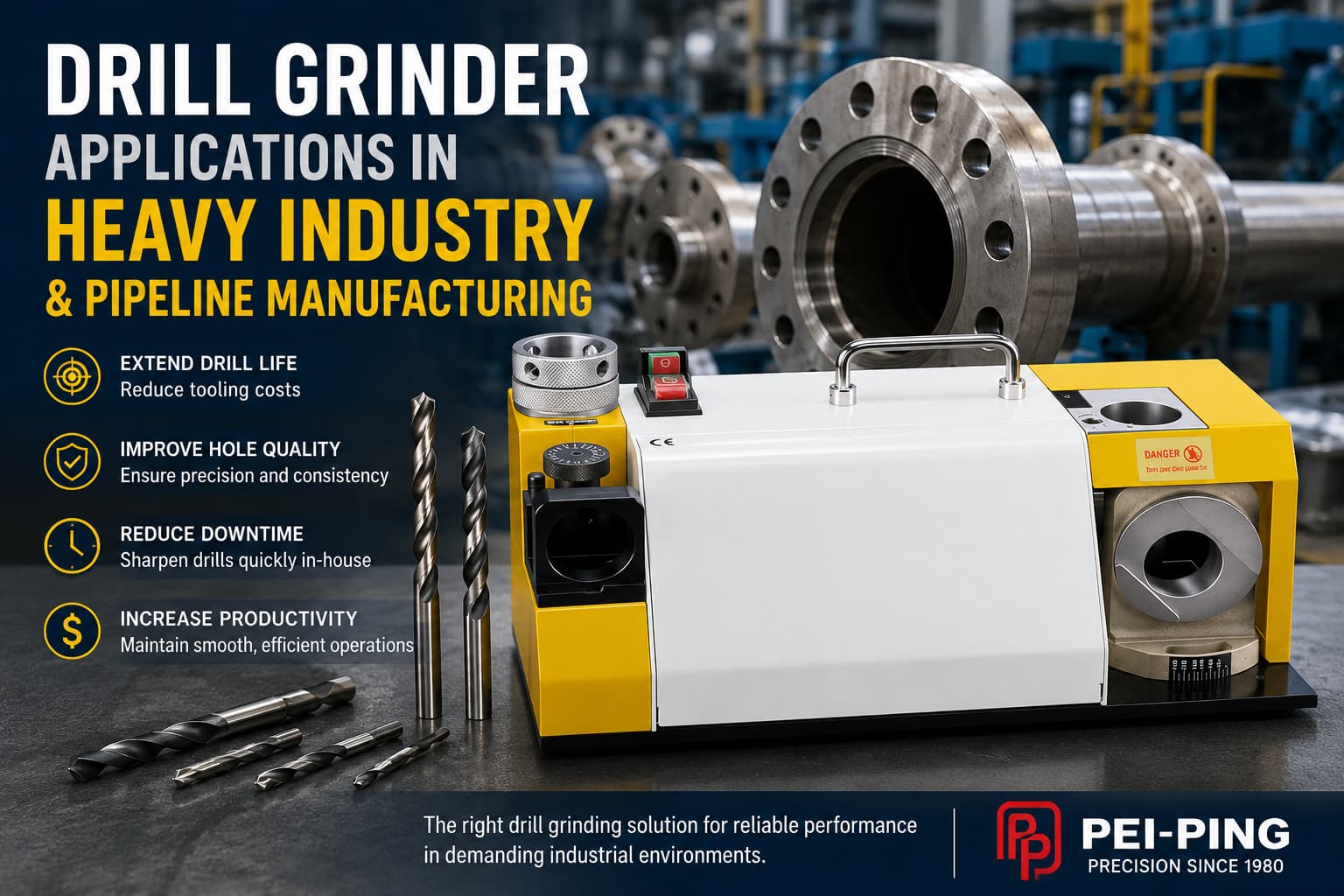
In heavy industry and pipeline manufacturing, drill bits are among the most frequently used cutting tools. Whether producing pipeline flanges, pressure vessels, valve bodies, or structural steel components, drilling operations are essential to the manufacturing process.
However, as production volumes increase, manufacturers often face the same challenges: rising tooling costs, declining hole quality, unexpected downtime, and frequent drill replacement.
Rather than continuously purchasing new drill bits, many manufacturers are now turning to drill grinders as a practical solution. By restoring worn drills to their original cutting condition, a drill grinder helps improve productivity, reduce tooling expenses, and maintain consistent machining quality.
For companies involved in heavy industry and pipeline manufacturing, tool reconditioning is no longer just maintenance—it has become an important part of cost management and production efficiency.
Drill bits gradually wear during normal operation. In heavy industrial applications, this wear occurs even faster due to:
As drills become dull, manufacturers may experience:
Many shops simply replace worn drills and move on. While this may seem like the easiest solution, it often leads to excessive tooling costs and unnecessary waste.
The reality is that many drill bits still have substantial usable life remaining—the cutting edges simply need to be restored.
A drill grinder, also known as a drill sharpening machine, is specifically designed to restore worn drill bits by regrinding their cutting edges and drill point geometry.
Instead of discarding a drill when performance declines, manufacturers can recondition the tool and return it to production.
For heavy industry and pipeline manufacturers, this provides several immediate benefits:
By bringing drill sharpening in-house, manufacturers gain greater flexibility and no longer need to rely entirely on replacement tools or external sharpening services.
Heavy industry encompasses a wide range of sectors, including:
Many of the components produced in these industries require highly accurate drilled holes for assembly and operation.
Examples include:
Even minor deviations in hole size or position can affect assembly quality and overall system performance.
Maintaining drill accuracy therefore becomes critical for manufacturers seeking to meet quality standards and avoid costly rework.
Pipeline manufacturing presents unique drilling challenges because many components require large numbers of accurately positioned holes.
Common applications include:
Flanges require multiple bolt holes with precise spacing and dimensions. Worn drill bits can lead to alignment issues during installation.
Valve components often require precision drilling to ensure proper sealing and performance under pressure.
Pressure vessel fabrication demands strict adherence to dimensional tolerances and quality standards.
Accurate hole machining helps ensure leak-free assembly and long-term reliability.
For these applications, maintaining sharp drills directly contributes to product quality and manufacturing efficiency.
One of the most significant advantages of a drill grinder is the ability to reuse drill bits multiple times.
Rather than treating drills as disposable consumables, manufacturers can maximize the value of every tool investment.
In high-volume manufacturing environments, tooling expenses can quickly become substantial.
A drill grinder helps reduce the frequency of new drill purchases, lowering overall operating costs.
Properly sharpened drill bits produce:
These benefits are particularly important in industries where dimensional accuracy directly affects assembly performance.
When drills can be reconditioned immediately, production interruptions are minimized.
This is especially valuable for facilities operating under tight schedules and demanding delivery requirements.
For more than four decades, Pei-Ping Precision Enterprise Co., Ltd. has specialized in the development and manufacture of professional grinding machines.
Pei-Ping's drill grinding solutions are widely used by manufacturers seeking to improve tool management and reduce production costs.
Our equipment helps customers:
With extensive experience serving industries such as automotive, petrochemical, heavy equipment, mold manufacturing, and general machining, Pei-Ping continues to provide practical grinding solutions for modern manufacturing challenges.
Traditionally, drill bits were simply replaced when they became worn.
Today, manufacturers are increasingly shifting toward a more strategic approach.
Instead of asking:
"When should we buy new drills?"
Many companies now ask:
"How can we maximize the value of every drill we already own?"
This change in mindset transforms tooling from a recurring expense into a manageable asset.
A drill grinder plays a key role in making that transition possible.
Heavy industry and pipeline manufacturing depend on accurate, reliable drilling operations. As tooling costs continue to rise, manufacturers need smarter ways to control expenses while maintaining quality.
A professional drill grinder provides a practical solution by extending tool life, improving hole quality, reducing downtime, and lowering overall tooling costs.
For manufacturers looking to improve efficiency and establish a more sustainable tooling strategy, investing in drill grinding technology is no longer just a maintenance decision—it is a competitive advantage.
Contact Pei-Ping Precision Enterprise Co., Ltd. today to learn how the right drill grinding solution can support your heavy industry or pipeline manufacturing operation.
This site uses cookies to improve your browsing experience. we’ll assume you’re OK to continue. If you want to read more about this, please click Privacy Policy , thank you.