
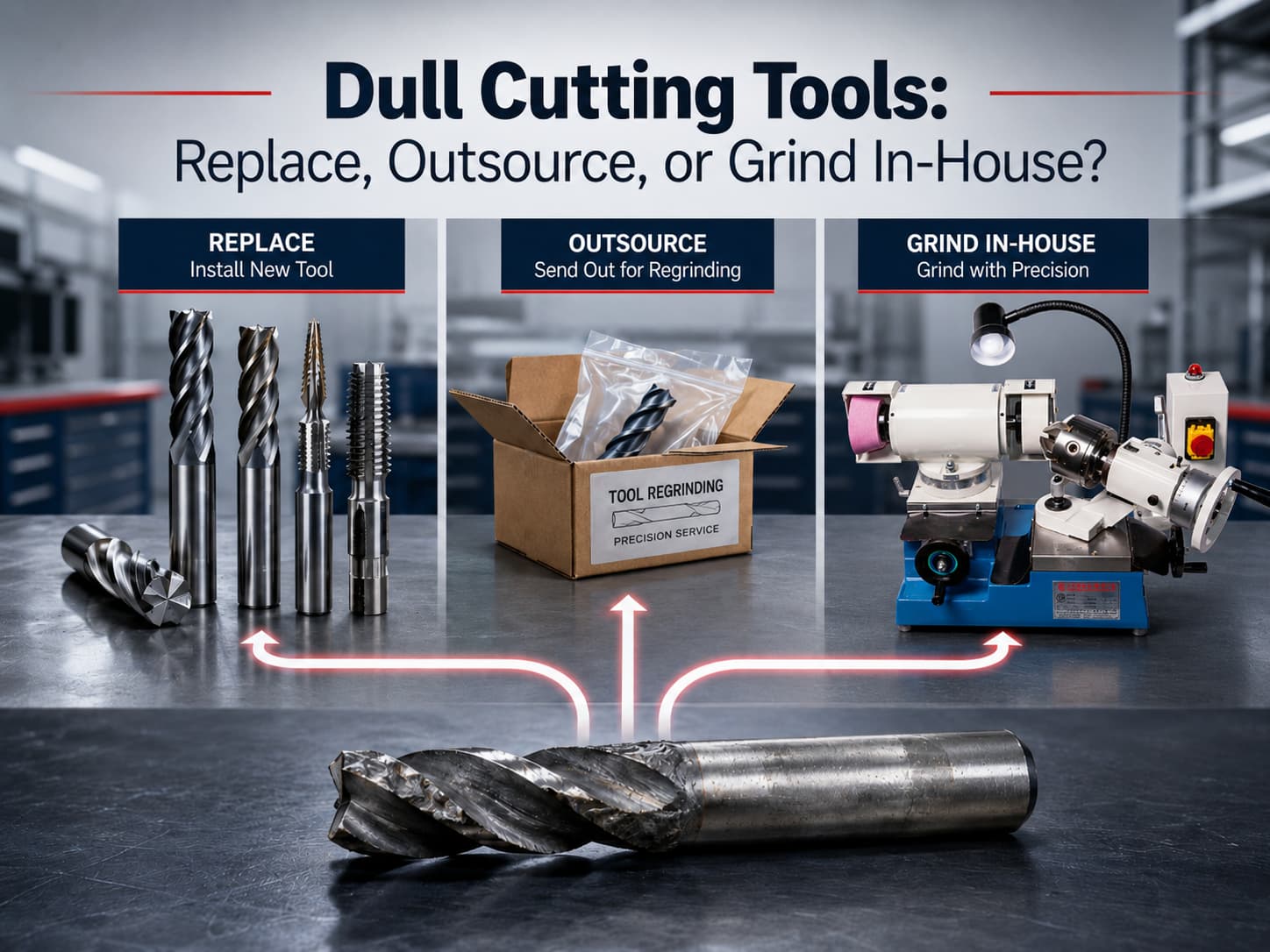
A dull cutting tool does not always belong in the scrap bin. Depending on its condition, value, geometry, and how frequently your shop uses the same type of tool, you may have three practical choices: replace it with a new tool, send it to an external regrinding service, or sharpen it in-house.
Each option can make sense under the right circumstances.
For a small workshop that only replaces a few low-cost drill bits occasionally, purchasing grinding equipment may not be necessary. For a manufacturer using large quantities of drills, end mills, taps, reamers, or special cutting tools every week, however, repeatedly buying new tools or waiting for outsourced regrinding can become expensive and disruptive.
The real question is therefore not simply:
"Can this tool be sharpened?"
It is:
"Which tool maintenance strategy makes the most sense for our production volume, tool value, turnaround requirements, and available technical capability?"
This guide compares the three options to help manufacturers make a more practical decision.
Before deciding whether to replace, outsource, or grind in-house, the first step is to determine whether the tool is still suitable for regrinding.
A cutting tool that has simply become dull may still have usable life remaining. In many cases, controlled regrinding can restore the cutting edge and allow the tool to return to service. However, regrinding is not appropriate for every worn tool.
A tool may be a candidate for regrinding when:
Replacement may be more appropriate when:
The key is not to assume that every dull tool should be discarded—or that every worn tool must be reground.
For drill users specifically, visible signs such as increased cutting force, overheating, slower drilling, and rough or inaccurate holes can indicate that sharpening should be considered. For a closer look at drill wear and sharpening, see What Can I Do If My Drill Bit Dull?
The economic value of regrinding can become even more significant for higher-value cutting tools. For manufacturers using PCD, PCBN, CBN, or carbide tooling, specialized grinding equipment may be required to restore suitable worn tools accurately. PEIPING's PP-DM Diamond & PCBN Tool Grinder is designed specifically for grinding PCD, PCBN, CBN, and carbide tools.
Buying a new tool is often the simplest solution. There is no sharpening process to manage, no grinding equipment to operate, and no external regrinding schedule to coordinate.
For some manufacturers, this is also the most economical choice.
Replacing the tool may be appropriate when:
For example, a small workshop that uses only a few standard, low-cost drill bits each month may find that direct replacement requires less effort than establishing a formal tool regrinding process.
The calculation changes, however, when tool consumption increases.
A manufacturer using hundreds of drills, end mills, or other cutting tools over time may face significantly different economics. Even moderate individual tool costs can accumulate into a substantial recurring expense when large quantities are consumed.
Replacement is therefore convenient, but convenience alone should not determine the strategy. Manufacturers should also consider annual tool consumption, inventory requirements, purchasing lead times, and the remaining usable value of worn tools.
Outsourced regrinding offers a middle ground between continuously purchasing new tools and investing in an in-house grinding process.
Instead of buying a replacement every time a tool becomes dull, the manufacturer collects suitable worn tools and sends them to a specialized regrinding supplier.
The external service provider may handle inspection, sharpening, geometry restoration, and—in some cases—additional processes such as recoating, depending on its capabilities.
Outsourcing may be suitable when:
This approach allows manufacturers to obtain more use from suitable cutting tools without immediately investing in grinding equipment, operator training, grinding wheels, fixtures, or maintenance.
However, outsourcing also creates additional factors to manage.
Depending on the service provider and location, manufacturers may need to consider:
The actual impact varies significantly between manufacturers. A shop with sufficient spare tools and predictable production may have no difficulty waiting for outsourced regrinding. A high-volume plant dealing with urgent production changes may find external turnaround more challenging.
The decision between outsourcing and internal processing also appears in other grinding operations. Manufacturers interested in the broader strategic considerations can read Outsourcing vs. In-House: Why a Compact Surface Grinder Is Your Best Investment for 2025.
In-house regrinding means bringing suitable grinding capability directly into your own workshop, tool room, maintenance department, or production facility.
Instead of waiting until worn tools can be shipped out and returned, your team can inspect and sharpen suitable tools internally according to production needs.
This option requires more initial commitment than simply buying replacements or outsourcing. Equipment must be selected, operators must understand the relevant grinding procedures, and consumables and maintenance need to be managed.
However, for the right manufacturing environment, in-house grinding can provide important advantages.
It may be suitable when:
The greatest benefit is not necessarily that every tool suddenly becomes cheaper. The real advantage is control.
With an appropriate in-house process, manufacturers can decide when a suitable tool is inspected, when it is reground, and when it returns to production rather than depending entirely on new-tool availability or external service schedules.
Timely sharpening can also prevent some tools from continuing to operate until wear becomes excessive. For more information about the relationship between regular sharpening and usable tool life, see Enhancing Tool Longevity with Grinders.
There is no universal answer for every manufacturer. The right choice depends on the value and quantity of tools, production demands, available skills, and required turnaround time.
| Factor | Replace with New Tool | Outsource Regrinding | Grind In-House |
|---|---|---|---|
| Initial equipment investment | Low | Low | Higher |
| Internal grinding skill required | No | No | Yes |
| Turnaround control | Depends on tool inventory and supplier availability | Depends on external service provider | Greater internal control once the process is established |
| Suitable for low tool volume | Yes | Often | Not always economical |
| Suitable for frequent recurring tool wear | Can become costly over time | Possible, but lead time should be considered | Often worth evaluating |
| Complex special tools | Replacement may be necessary | Specialized supplier may be suitable | Requires appropriate machine and expertise |
| Emergency tool availability | Requires spare inventory | May be difficult during external processing | Tools may be handled internally when capability is available |
| Quality control | Tool manufacturer | External service provider | Internal process control |
| Best suited for | Low-cost, damaged, or infrequently used tools | Low-to-moderate volumes or specialized tools | Frequent recurring sharpening needs |
The comparison should not be based on machine price alone. The entire tool management process should be considered.
One of the most common mistakes is to ask only:
"How much does a tool grinder cost?"
A better question is:
"How much are we currently spending because we do not have the right in-house grinding capability?"
Consider the following cost factors.
How many drills, end mills, taps, or other cutting tools are replaced every month or year?
Of these, how many are genuinely unusable, and how many are discarded primarily because their cutting edges have become dull?
How much is currently paid to external suppliers for regrinding?
Remember to include more than the quoted sharpening price.
Depending on your operation, total costs may also involve:
How long does it take before tools return from the external supplier?
Does the company need additional backup tools to compensate for this waiting period?
What happens when the required sharp tool is not available?
The impact may range from a minor inconvenience to production rescheduling, longer setup times, delayed orders, or machine idle time.
An in-house grinding process also has costs and should not be treated as free.
Consider:
A realistic decision compares the total current cost of replacement and outsourcing with the total cost of owning and operating suitable grinding equipment.
For manufacturers facing rising carbide tool expenses, this issue becomes particularly important. PEIPING has discussed this topic in more detail in How to Reduce Cutting Tool Costs When Carbide Prices Keep Rising.
Another important point is that "in-house tool grinding" does not automatically mean purchasing a large, highly automated CNC grinding system.
The appropriate equipment depends on:
A workshop sharpening standard drill bits has very different requirements from a cutting tool manufacturer producing complex carbide tools in quantity.
This is why choosing the right level of grinding equipment is important.
PEIPING provides several categories of grinding equipment for different tool maintenance and production requirements.
For workshops that regularly sharpen standard drill bits or end mills, a dedicated compact grinder can provide a more focused solution.
PEIPING's Portable Drill Grinder & End Mill Grinder range includes models designed for different tool types and diameter ranges, including dedicated drill grinders, end mill grinders, and combination machines.
This type of solution may suit:
For manufacturers that regularly regrind end mills, the PP-25 Precision End Mill Grinder is specifically designed for grinding 2-, 3-, 4-, and 6-flute end mills, including end cutting edges, relief areas, end gashes, and peripheral cutting edges.
For companies using both drills and end mills, a combination machine may also be worth considering. Read Can a Grinder Handle Both Drill Bits and End Mills? Here's the Answer for a closer look at this approach.
Manufacturers working with a broader variety of cutting tools may require greater flexibility.
A Universal Tool and Cutter Grinder can be suitable for different grinding tasks, depending on the machine model, tooling, accessories, grinding wheel selection, and operator capability.
Potential applications may include:
For example, the PP-60N Universal Tool & Cutter Grinder is designed to securely hold drills and can grind the cutting edge and web thickness in one setup, helping maintain equal drill angles, equal edge lengths, and drill center accuracy.
This type of machine is particularly relevant for tool rooms, tool manufacturers, regrinding service providers, and production facilities handling a more diverse cutting tool inventory.
Some cutting tools require specialized grinding processes because of their size, application, or geometry.
Examples may include:
In these cases, a dedicated special-purpose grinder may provide a more suitable solution than trying to adapt a general-purpose machine to every application.
Where higher production volumes, automation, and repeatability become priorities, CNC automatic grinding equipment may be considered.
This is more relevant to manufacturers that produce or regrind tools in quantity and need a more automated process than manual or dedicated compact grinding machines can provide.
The best grinder is not necessarily the largest or most automated one. It is the machine that matches the actual tool type, size range, grinding frequency, production volume, and accuracy requirements.
Still unsure which option is right for your operation? Start with these questions.
Some manufacturers may even use all three strategies at the same time.
For example, a company might:
In many real manufacturing environments, this hybrid approach can be more practical than forcing every cutting tool into a single maintenance strategy.
When a cutting tool becomes dull, buying a new one is not the only possible answer. But regrinding is not automatically the best answer either.
The right decision depends on the condition and value of the tool, how often the same type is used, how quickly it must return to production, and whether your operation has enough recurring grinding demand to justify bringing the process in-house.
For occasional use of inexpensive tools, replacement may be the simplest option.
For limited quantities of valuable or complex tools, professional outsourced regrinding may be more practical.
For manufacturers that repeatedly use drills, end mills, taps, reamers, and other cutting tools—and where waiting time, tool inventory, or recurring replacement costs have become a concern—developing in-house grinding capability may deserve serious consideration.
PEIPING PRECISION ENTERPRISE CO., LTD. provides a broad range of tool grinding solutions, from compact drill and end mill grinders to universal tool and cutter grinders, special-purpose grinding machines, diamond and PCBN tool grinders, and CNC automatic grinders.
The goal is not to put every customer into the same machine. It is to identify the right grinding approach according to your tool type, tool size, geometry, grinding frequency, production volume, and accuracy requirements.
Tell PEIPING about the cutting tools you use, their dimensions, how frequently they require sharpening, and your production requirements. Our team can help you evaluate the appropriate grinding solution for your application.
Contact PEIPING to discuss your tool grinding requirements.
This site uses cookies to improve your browsing experience. we’ll assume you’re OK to continue. If you want to read more about this, please click Privacy Policy , thank you.