
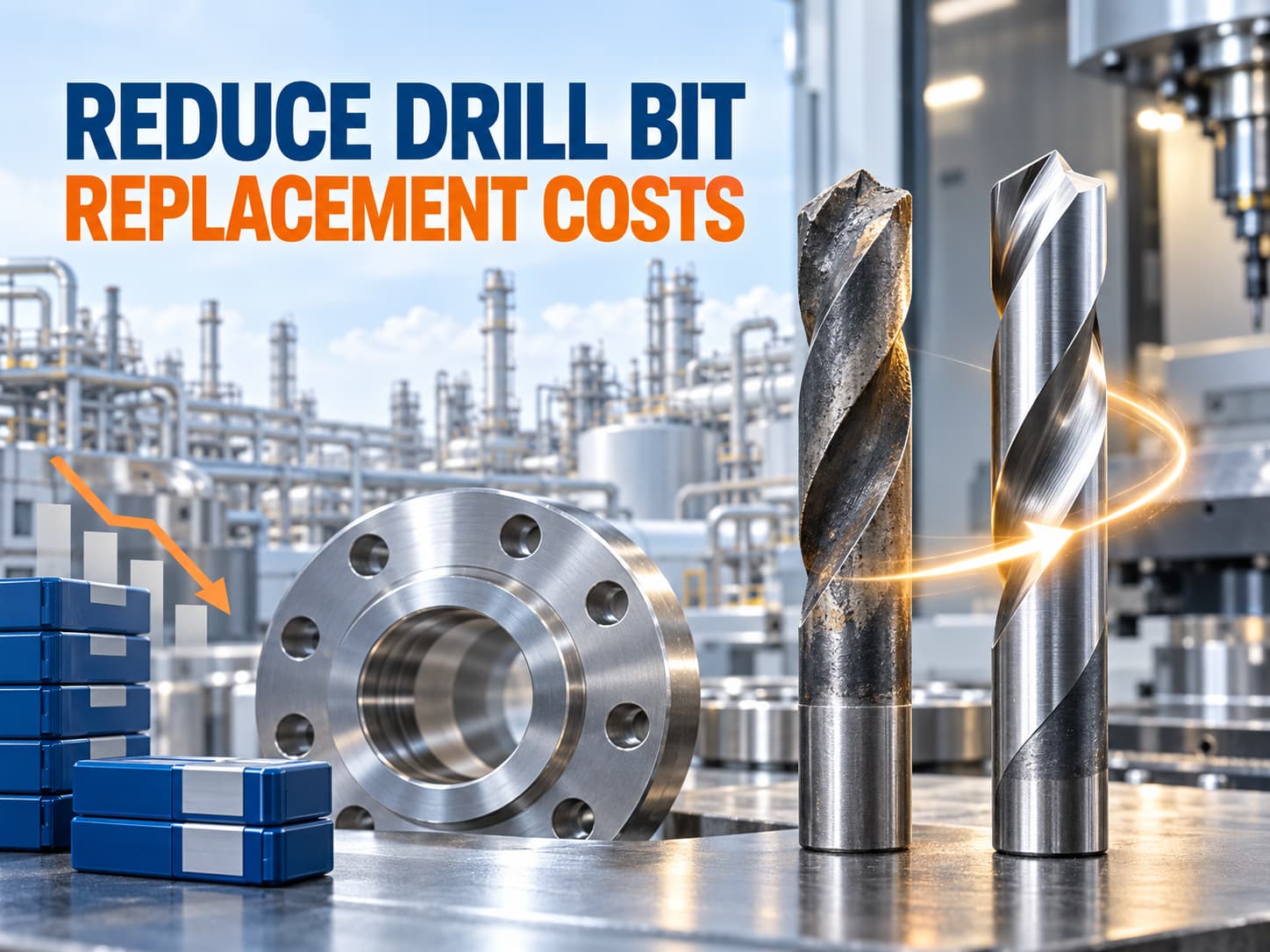
Drill bit replacement is no longer only a maintenance issue. As tungsten supply constraints place greater pressure on carbide tooling costs, petrochemical component manufacturers need a more controlled strategy for extending tool life, reducing emergency purchases, and keeping frequently used drills available for production.
Drills used to machine pipeline flanges, valve bodies, pump housings, heat exchanger components, and pressure vessel parts often operate under demanding conditions. Hard materials, large hole diameters, long drilling cycles, and repeated production runs can accelerate cutting-edge wear.
When drilling performance declines, replacing the drill may appear to be the fastest solution. However, frequent replacement can gradually increase tooling expenses—especially when a facility relies on large-diameter, carbide, carbide-tipped, or specialized drill bits.
A more cost-effective strategy is to identify worn drills that can still be reground, restore their cutting geometry with a suitable universal tool and cutter grinder, and manage them as reusable production assets.
Why Drill Bit Replacement Costs Rise So Quickly
The purchase price of a drill bit is only one part of its actual cost. Frequent replacement can also create additional expenses related to purchasing, inventory, machine downtime, and production planning.
Replacement costs commonly increase when manufacturers face:
- Accelerated wear from difficult-to-machine materials
- Large-diameter drills with higher unit prices
- Premature replacement of tools that could still be reground
- Long lead times for specialized drill bits
- Excess safety stock maintained to prevent production interruptions
- Inconsistent tool condition that leads to scrap or rework
- Emergency purchases made to keep urgent orders moving
These costs can become particularly significant when the same hole specifications are produced repeatedly. If drills are discarded as soon as their performance declines, much of their remaining usable material may never be utilized.
The challenges are especially relevant to petrochemical component manufacturing, where large holes and demanding workpiece materials can accelerate tool consumption.
Rising Tungsten Prices Are Changing the Cost of Carbide Tooling
Tool replacement costs are also being affected by changes in the global tungsten market. Tungsten is a key raw material used in cemented carbide, which is widely applied in high-performance cutting tools that require hardness, heat resistance, and wear resistance.
According to the U.S. Geological Survey’s 2026 tungsten report, China introduced export controls on selected tungsten products in February 2025, while tungsten prices rose sharply during the year. Reuters also reported that tungsten prices reached record highs in January 2026 as export restrictions, tighter inventories, and industrial demand placed additional pressure on global supply.
This does not mean that every drill bit will increase in price at the same rate. Final tool prices still depend on the drill material, carbide content, diameter, geometry, manufacturer, order volume, and regional supply conditions. HSS drills, solid-carbide drills, and carbide-tipped tools are also affected differently.
However, manufacturers that rely on tungsten-containing cutting tools may face greater purchasing uncertainty and higher replacement costs. Under these conditions, treating every worn drill as disposable becomes increasingly expensive.
A controlled regrinding program can help manufacturers extract more usable life from suitable tools, reduce exposure to replacement-price fluctuations, and improve control over their annual tooling budget.
Replace the Drill—or Regrind It?
A worn cutting edge does not necessarily mean the entire drill has reached the end of its service life. If the drill body remains in usable condition, its cutting geometry may be restored through controlled regrinding.
Before deciding whether to replace or regrind a drill, inspect the following conditions:
| Inspection Point | Regrinding May Be Suitable When | Replacement May Be Necessary When |
|---|---|---|
| Cutting edge | Wear is limited to the grindable area | Severe chipping extends beyond the repairable area |
| Drill body | The body remains straight and stable | The body is bent, cracked, or structurally damaged |
| Flutes | Flutes remain structurally usable | Flutes have serious damage or excessive wear |
| Remaining length | Sufficient material remains for reuse | The tool is below the acceptable usable length |
| Application requirement | The required geometry can be reliably restored | The tool can no longer meet the required specification |
Establishing clear acceptance criteria prevents two costly mistakes: discarding a usable drill too early or returning a severely damaged tool to production.
How In-House Drill Grinding Reduces Tooling Costs
1. Extend the Usable Life of Each Drill
Professional regrinding removes worn material and restores the drill point for another production cycle. Depending on the drill’s condition and remaining length, the same tool may be suitable for multiple regrinding cycles.
This allows manufacturers to obtain more value from each drill and reduce the number of new tools purchased over time. For expensive or large-diameter drills, even a limited number of successful regrinding cycles can make a noticeable difference in annual tooling expenditure.
2. Reduce Dependence on External Sharpening Services
Outsourced regrinding can be practical for low tool volumes or highly specialized work. However, shipping, service queues, inspection, and return transportation all add to turnaround time.
When frequently used drills can be sharpened in-house, the maintenance team gains more control over when tools return to production. External services can then be reserved for uncommon or specialized tools that require capabilities unavailable internally.
Facilities working with smaller or standard drill sizes may also evaluate a portable drill grinder when ease of operation and shorter tool turnaround are the primary requirements.
3. Avoid Emergency Replacement Purchases
Unexpected drill wear can force a manufacturer to place an urgent replacement order. Rush purchasing, small order quantities, and expedited delivery can make each replacement more expensive.
An in-house drill grinder provides another option. The worn tool can be inspected, reground when appropriate, and returned to production without waiting for a new drill to arrive.
This is particularly valuable when a facility uses non-standard or large-diameter drills that may not be immediately available from local inventory.
4. Maintain a More Predictable Drill Inventory
Without a structured regrinding process, facilities may hold excessive quantities of spare drills to protect production schedules. This ties up purchasing budgets and storage space.
A controlled sharpening program makes drill availability more predictable. Manufacturers can separate their inventory into:
- Tools ready for production
- Tools awaiting inspection
- Tools approved for regrinding
- Tools sent for outsourced maintenance
- Tools that must be replaced
This visibility helps purchasing teams order new tools based on actual demand instead of uncertainty.
5. Reduce Problems Caused by Worn Drills
Continuing to use a dull or incorrectly ground drill may increase cutting resistance, cutting temperature, burr formation, and dimensional variation. These problems can affect hole quality and may contribute to tool breakage, rework, or interrupted production.
The purpose of regrinding is therefore not simply to make a drill “sharp again.” Its cutting geometry must be restored consistently so the tool can return to the required machining condition.
Why Grinding Consistency Matters
Manual touch-ups may create visible sharpness, but the two cutting edges can still differ in length, angle, or relief. An incorrectly ground drill may cut unevenly, wander during entry, produce an oversized hole, or wear prematurely.
For petrochemical component manufacturing, drill regrinding should focus on repeatable geometry, including:
- Balanced cutting-edge lengths
- A suitable point angle
- Consistent relief
- Correct center geometry
- Stable tool holding during grinding
A dedicated drill grinder makes these results easier to reproduce than an uncontrolled manual process. Consistency is especially important when drills are repeatedly used for the same flange, valve, pump, heat exchanger, or pressure-component specifications.
Choosing the Right Drill Grinder for the Tool Range
A drill grinder should be selected according to the tools used in production—not simply according to the machine’s maximum grinding capacity.
Manufacturers should first review:
- Minimum and maximum drill diameter
- Drill types and tool materials
- Required drill point geometry
- Monthly regrinding volume
- Operator experience
- Available workshop space
- Need to regrind other cutting tools
- Frequency of large-diameter drill maintenance
PEIPING provides universal tool and cutter grinders for different industrial tool-size requirements:
| Model | Published Drill Grinding Range | Suitable Consideration |
|---|---|---|
| PP-60N | 2–60 mm | Facilities handling small, medium, and selected larger drills |
| PP-80N | 4–80 mm | Plants using a broader range of industrial drill diameters |
| PP-100N | 5–100 mm | Heavy-industry applications requiring large-diameter drill maintenance |
The PP-100N Universal Tool & Cutter Grinder is particularly relevant when petrochemical component production involves large holes and drills up to 100 mm. Its precision awl-type chuck is designed to hold the drill securely while supporting the grinding of the cutting edge and web thickness in one setup.
However, diameter capacity alone should not determine the selection. The drill material, point geometry, flute condition, production volume, and required grinding operations should all be confirmed before choosing a machine.
Build a Regrinding Program, Not Just a Grinding Station
Purchasing a drill grinder does not automatically reduce costs. The equipment should be supported by a simple and repeatable tool-management process.
Define When a Drill Should Be Removed
Do not wait until a drill is severely damaged. Operators should remove it from production when predefined wear indicators appear, such as:
- Declining hole quality
- Increased spindle load or cutting resistance
- Abnormal noise during drilling
- Excessive heat
- Larger or inconsistent burrs
- Visible cutting-edge wear
Earlier intervention generally leaves more usable material available for controlled regrinding.
Record Each Regrinding Cycle
Assigning an identification number to valuable drills makes it possible to record:
- Original purchase date and price
- Application and workpiece material
- Number of regrinding cycles
- Inspection results
- Tool performance after regrinding
- Reason for final replacement
This information helps manufacturers understand actual tool life and identify drills, workpiece materials, or machining processes with unusually high tool consumption.
Standardize the Grinding Setup
Document the approved setup for regularly used drills. Recording the point angle, relief requirements, grinding wheel selection, and inspection method helps different operators achieve more consistent results.
Inspect Before Returning the Drill to Production
A reground drill should be checked before it is released. Depending on the application, inspection may include cutting-edge symmetry, point geometry, remaining length, visible damage, and a controlled test cut.
Tools with structural damage or insufficient remaining material should not be returned to production simply to avoid purchasing a replacement.
When Does In-House Regrinding Make Financial Sense?
The decision should be based on the facility’s actual tool consumption rather than a general assumption.
Annual Replacement Cost
Annual Outsourced Regrinding Cost
Estimated In-House Regrinding Cost
In-house regrinding is more likely to provide value when a facility:
- Uses drills frequently
- Purchases expensive or large-diameter drills
- Experiences long outsourced turnaround times
- Maintains excessive backup inventory
- Regularly places emergency tool orders
- Requires faster control over tool availability
For facilities with low regrinding volumes, outsourcing may remain the more practical option. Some manufacturers may benefit from a hybrid system: routinely used drills are maintained internally, while uncommon or highly specialized tools are sent to an external service provider.
Reduce Replacement Costs Without Compromising Production Quality
Reducing drill bit replacement costs does not mean continuing to use tools beyond their safe or practical limits. It means extracting more value from suitable drills while maintaining controlled cutting geometry and predictable machining results.
For petrochemical component manufacturers, an effective strategy combines:
- Timely removal of worn drills
- Clear regrind-or-replace criteria
- Consistent grinding procedures
- Tool history and cost records
- Final inspection before reuse
- A drill grinder matched to the actual tool range
As tungsten supply and carbide tooling costs become less predictable, the ability to recondition suitable drills can provide both operational and financial value.
Build a More Controllable Tooling-Cost Strategy
PEIPING offers tool grinding solutions for different industrial tool sizes, including equipment capable of handling drills up to 100 mm.
By matching the grinder to the tool diameter, geometry, production volume, and internal maintenance requirements, manufacturers can reduce unnecessary drill purchases, shorten tool turnaround time, and improve control over long-term tooling costs.