
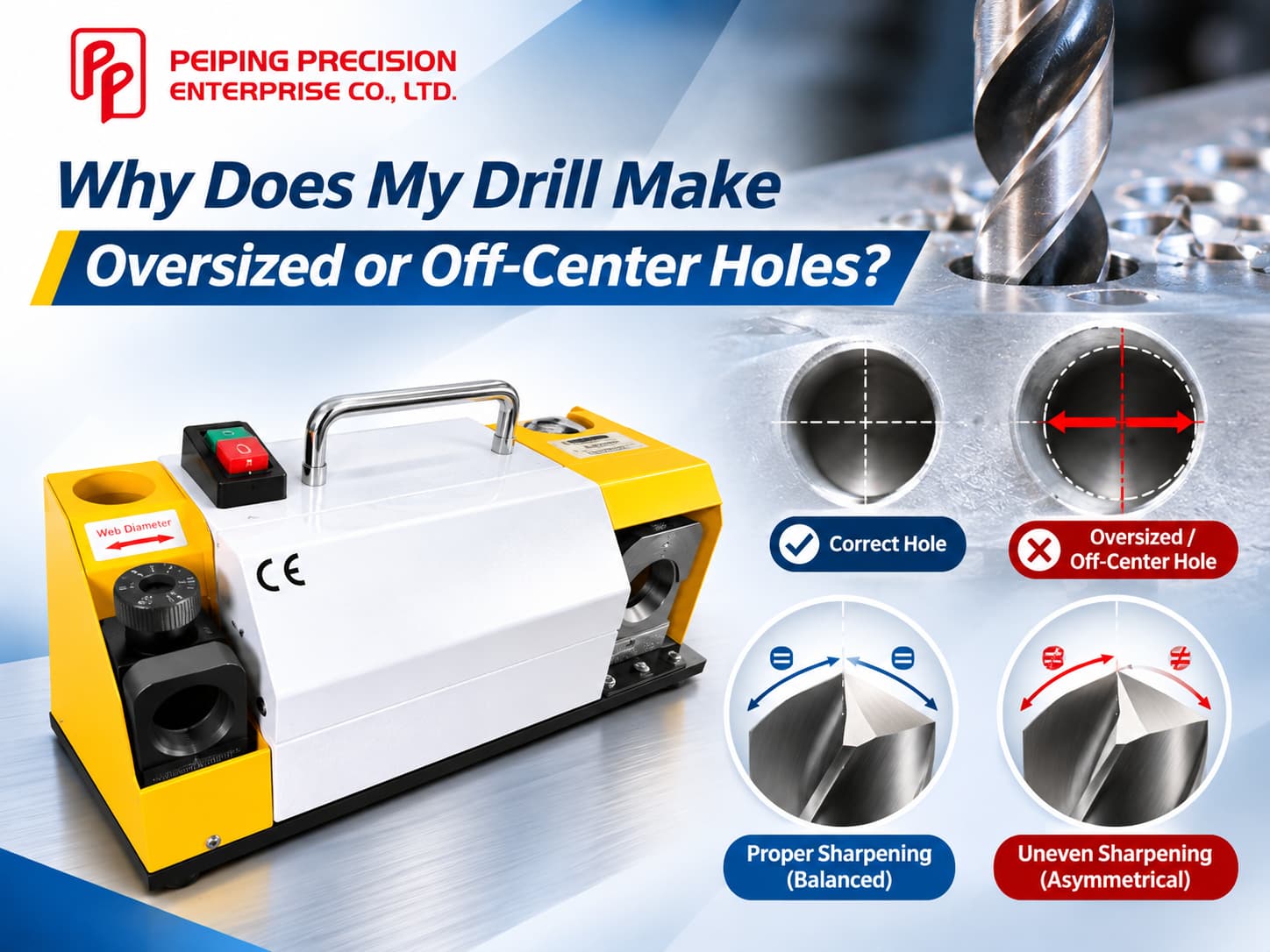
Oversized or off-center holes can result from uneven drill sharpening, tool runout, unstable clamping, or unsuitable drilling conditions. One common cause is asymmetrical drill point geometry, which creates unbalanced cutting forces and may cause drill walking, vibration, or inaccurate hole dimensions.
Identifying the source of the problem before adjusting machining parameters can help manufacturers improve drilling accuracy and avoid unnecessary tool replacement.
1. Common Drilling Problems and Their Causes
Different drilling defects require different corrective actions. The following table helps identify where to begin troubleshooting.
| Drilling Problem | Possible Causes | First Inspection |
|---|---|---|
| Oversized holes | Uneven cutting lips, tool runout, vibration | Drill geometry and runout |
| Off-center holes | Drill walking, positioning errors, deflection | Drill entry and alignment |
| Drill bit walking | Off-center drill point, insufficient starting guidance | Drill point and entry conditions |
| Chatter or vibration | Poor rigidity, excessive overhang, unsuitable cutting parameters | Toolholding and workholding |
| Poor surface finish | Worn edges, vibration, chip evacuation problems | Cutting edges and chip removal |
An oversized hole does not necessarily indicate an incorrect drill diameter. Check both tool geometry and machining conditions before replacing the drill.
2. How Does Uneven Drill Sharpening Affect Hole Accuracy?
Uneven drill sharpening can affect cutting balance, especially when the two cutting lips differ in length, angle, or clearance.
Unequal Cutting Lip Lengths
When one cutting lip is longer than the other, cutting forces may become unbalanced, contributing to drill deflection and oversized holes.
Off-Center Drill Point
An incorrectly centered drill point can increase the risk of drill walking during initial contact with the workpiece, affecting hole positioning.
Unequal Clearance Angles
Inconsistent clearance behind the cutting lips can cause one side to rub rather than cut efficiently, increasing heat, vibration, and edge wear.
For additional information about drill sharpening fundamentals, see The Crucial Role of Drill Bit Sharpening .
3. How to Troubleshoot Oversized or Off-Center Holes
Follow these five steps to identify and correct drilling accuracy problems.
Step 1: Measure the Hole Error
Check whether the problem involves hole diameter, position, or both. This helps distinguish cutting imbalance from positioning errors.
Step 2: Check Toolholding and Runout
Inspect the toolholder, spindle, workpiece clamping, and drill overhang. Measure runout near the cutting end with a suitable indicator.
Step 3: Inspect Drill Point Geometry
With the machine safely stopped, examine cutting lip lengths, point centering, clearance angles, and edge wear.
Step 4: Apply the Appropriate Correction
Regrind an asymmetrical drill point using a suitable drill bit sharpening machine. If the geometry is correct, investigate cutting parameters, alignment, and entry conditions.
Step 5: Verify with a Test Hole
Drill a test hole and measure its diameter and position. Change one factor at a time to confirm which correction improves accuracy.
4. When Should You Regrind or Replace a Drill Bit?
Regrinding may restore cutting performance when the drill has worn edges or incorrect point geometry. However, severely damaged tools may require replacement.
| Drill Condition | Recommended Action |
|---|---|
| Unequal cutting lips | Regrind and inspect symmetry |
| Incorrect clearance angles | Correct the grinding geometry |
| Minor edge wear | Regrind if the tool remains suitable |
| Severe chipping or structural damage | Evaluate replacement |
| Correct geometry but excessive runout | Inspect toolholding and spindle |
For a broader comparison of tool maintenance options, read Should You Replace, Outsource Regrinding, or Grind In-House? .
6. Conclusion
Oversized or off-center holes require more than simply replacing the drill bit. By checking hole measurements, tool runout, and drill point geometry in the correct order, manufacturers can identify the cause and select an appropriate corrective action.
Improve Drill Sharpening Consistency with PEIPING
PEIPING Precision Enterprise Co., Ltd. provides drill grinding solutions to support consistent tool preparation. Contact our team to discuss your drill sharpening requirements.
Contact PEIPING